Questions
Questions I'm trying to de-layman myself on. More specifically, I'm trying to answer the question "what would I work on for 10 years if I knew it would be successful?"Inspired by Collison's and Alexey's pages. If you have a reading suggestion or a response, please email me.
1.Why is the polygraph still used despite poor reliability? What does a better alternative look like?
In controlled environments, accuracy of polygraphs varies widely from 50 to 90 percent. Plus, there are known countermeasures like biting your tongue to fool polygraph tests, which many spies have used to infiltrate the CIA.
For some reason, the CIA still uses polygraphs in its interview process and is still used commonly in our legal system (famously Dr. Christine Blasey Ford used it to substantiate sexual assault allegations on Supreme Court Justice Brett Kavanaugh).
The polygraph is an American phenomenon. It is scarcely used outside the US. The polygraph hasn't changed much since its conception in the 1930s other than additional respiration measurements and being slightly more computerized.
There is a lack of high quality research on polygraphs. Even if the commonly cited 90% accuracy is true, the 10% failure rate is incredibly high for something that determines career prospects and is used as evidence in our criminal justice system.
Are there better approaches using the same data with AI models trained to detect lying? Is there a chemical approach to creating a truth serum? Is there an EEG approach to read brain waves for more accurate lie detection?
2.Is ESP actually real?
Mitch Horowitz shows that an analysis of 90 precognition experiments from 33 labs in 14 countries found evidence its authors called decisive. However, ESP is still widely regarded as pseudoscience by LLM models and the scientific community.
What results can make ESP more conclusive / convincing? What other scientific areas regarded as "pseudoscience" are being overlooked? How can we get LLMs to be more questioning and rational about scientific evidence when it's trained on the consensus findings?
Highly recommend watching Mitch Horowitz lecture at Hereticon "ESP is real" https://www.youtube.com/watch?v=AQDILJb9yK8.
3.Can an AI agent effectively act as a life coach that pushes you to your ideal best version of yourself?
Most models have incredibly high flattery / sycophancy baked into training. If a user sets their "manifesto" with their goals and who they want to be in life, can context / a good system prompt be enough to reverse this inherent agreeableness in the model weights?
Using Muse / Grok Bot / Instinct doesn't seem to do the job. They constantly agree with rationalizations and a too strong system prompt tends to be contrarian for contrarian's sake.
If anyone has effective guardrails they are using for an agent to keep them on track, please reach out!
4.Is the battery the wrong way to store electricity for a car?
Palmer Luckey thinks the future of ground vehicles is steam, not battery packs. His pitch is a sealed steam engine fed by an insulated boiler that you charge from any fast charger. It stores electricity as heat, so there are no chemicals to wear out, it can charge at many megawatts, and it needs no lithium / cobalt / nickel. A version of this already existed: fireless locomotives were filled w/ steam from a factory boiler and worked for hours w/ no fire on board.
My rough math says storing the heat in the water itself doesn't work for a car, since the steel tank needed to hold the pressure weighs several times more than the water. The version that seems feasible keeps the heat in a solid block instead, which is what grid "thermal batteries" from Antora and Fourth Power do w/ carbon blocks at 2,000°C+. A carbon block cycled between 500°C and 1,800°C holds about 680 Wh of heat per kg. Here is how it could work:
The problem is the engine. 1970s steam car designs turned about 15% of their heat into motion, my math for a modern high-pressure loop gives around 30%, and the best power plant cycles approach 50%. A battery car gets over 77% from the grid to the wheels. So this car needs about 2.5x the electricity per mile and a much bigger radiator than a gas car to dump the waste heat. On weight it looks close: about 370 kg of carbon for 300 miles vs about 500 kg for a battery pack, before adding the engine and insulation.
Where it could win is charging and lifespan. A 5 minute charge is about 3 MW, which the truck charging standard already allows, and a block of carbon doesn't care how fast it's heated or how many times. But batteries are catching up: BYD has 1 MW charging that adds 400 km in 5 minutes and packs are down to $99 per kWh.
Is 2.5x the electricity worth it for a car that charges in 5 minutes and never loses range w/ age? Can a car-sized block really lose only 5% of its heat a day (Luckey's number) when grid-sized ones lose 1%? My math says closer to 10%+. Does this make more sense for a home, where the waste heat can warm the house? Was steam dropped for bad reasons or was the physics always worse?
5.What jobs could be done best by mass-producing an animal?
This is inspired by the incredible work being done by Colossal and Warhound. Dogs are used in the military as the best option (over robotics) for certain tasks like using their incredible smell to find explosives, tracking people, and searching buildings and tunnels.
Right now a plant in Panama makes about 100 million sterile flies a week to wipe out a livestock parasite. Black soldier flies are farmed to turn food waste into animal feed. Spiders make stronger fibre than silkworms but can't be farmed since they eat each other.
Warhound is genetically modifying dogs with CRISPR to create the best possible animal for the task at hand. What other high-impact tasks can a genetically modified animal be 10x better for than a purpose-built robot? Is there an opportunity for a next-gen "creature foundry" where you send in a spec and get an animal back?
6.Can we talk to animals? Which ones and why?
The Coller Dolittle Challenge offers $100K a year for the best research on two-way communication with animals, plus a $10M grand prize for when an animal talks with a research team without realizing it's talking to humans (basically a Turing test for animals). The 2026 finalists were working on zebra finches, African striped mice, chimpanzees and bonobos.
The bonobo team found that bonobos combine calls into structured sequences that resemble human sentences. Zebra finches use different call types to signal who they are and what they're doing. So far this is mostly decoding what animals say to each other, not talking back.
Which animal will we talk to first? My instinct says it's the ones w/ the most complex social lives (apes / whales / birds), but maybe it's just whichever species we can collect the most data on. If we could talk to an animal, what would we even ask? Does it have anything to say beyond food / danger / mating?
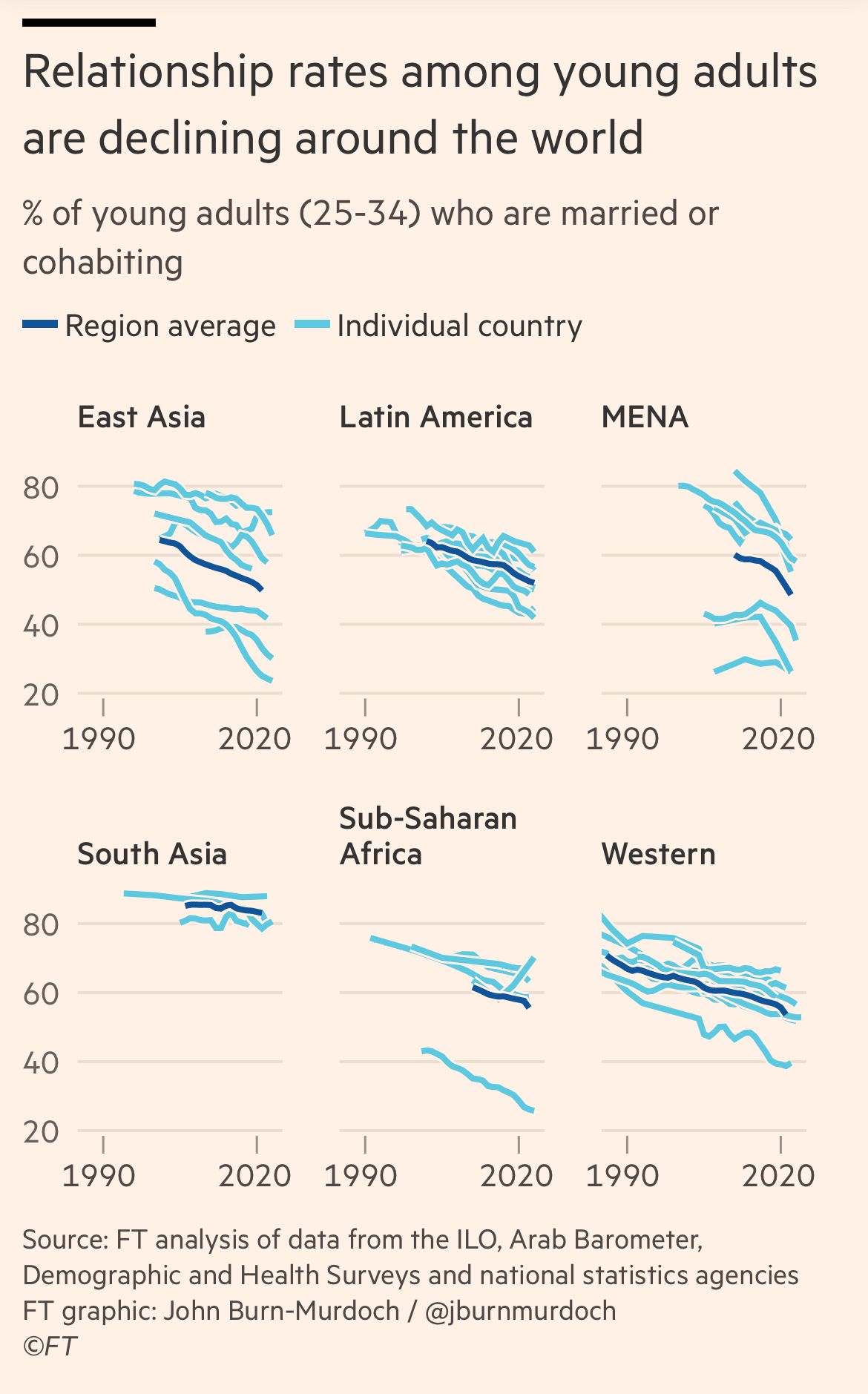
7.How do we solve declining birth rates?
It seems like birth rates trace the decline in relationship formation in many countries:
8.Why do around 10% of US adults still believe the Earth is flat?
Many polls keep landing around 10% in the US. France is at 9%, Brazil at 7% and Spain at 5%. Online polls typically tend to overstate rare beliefs so the real number could be much lower, but this is still millions of people.
Interviews with flat Earth conference attendees found that the causes were YouTube and distrust of instutitions. A study of 1,252 people in Spain found the best predictor was low science knowledge combined with high confidence. In 2024, flat earthers did a trip to Antarctica to see the 24 hour sun and most still didn't change their minds.
If first-hand evidence doesn't convince you to change a belief, what does? Are status incentives from being in a community enforcing false beliefs (see Will Storr's The Status Game)?
Honestly, changing flat earther's minds might not be the best use of resources. But if we can't change minds on this which can be quickly checked with a plane ticket or telescope, what does that say about larger issues like vaccines / climate / elections where evidence is much harder to see for yourself? Maybe flat earther belief reversals is a good low-stakes eval for understanding how to use AI to change people's beliefs for the better?
9.Can a marriage be chemically saved, and should it be?
This was inspired by Palmer Luckey's statement that a startup he'd build today is "oxytocin doping" for marriage counselling to end the "tragedy of divorce". My instinct says the idea of using love potions of some sort to save non-abusive marriages intentionally is good for everyone involved.
10.Why do we still trust personality tests that give people a different answer the second time?
As many as half of people get a different Myers-Briggs type when they retake it five weeks later. The publisher disputes this and reports strong retest scores on each of the four scales, but a small shift near the middle of one scale is enough to flip a letter. They also say the test is not validated for hiring. Still, about 76% of employers now use some kind of skills or personality test when hiring (per a company that sells them), and they are leaning on tests more because AI-written applications all look the same. My instinct says people like these tests because a type feels like an answer, not because it predicts anything. What would a personality test look like if it had to predict something real like job performance or who you'd work well w/? Is personality even stable enough to measure? Could an AI infer it from how you write better than a questionnaire can?
11.Why is the placebo effect getting stronger, and only in US drug trials?
An analysis of 84 pain drug trials from 1990 to 2013 found that placebo responses rose a lot over that period while drug responses stayed flat. This only happened in US trials. Trials in Europe and Asia showed no change, and the authors said it's still unclear why the US is an outlier.
US trials also got bigger and longer, and bigger trials had larger placebo responses. The US is also one of the only countries that allows drug ads on TV. Does advertising raise expectations enough to change trial results? If the placebo effect can get stronger w/ expectation, can we use that on purpose? How many drugs that would have passed in 1995 are failing trials today?
12.Can we need less sleep? A few people have a gene that lets them thrive on four to six hours - can crispr gene editing give everyone this gene?
Natural short sleepers sleep four to six hours a night and feel fully rested. UCSF researchers found the first gene (DEC2) in 2009 and a second (ADRB1) in 2019. Mice given the ADRB1 mutation also slept less.
These mutations are single-letter changes, which is what CRISPR base editors are designed for. But the edit would need to reach neurons in an adult brain, which seems much harder than editing blood or liver cells. Would a drug that mimics the mutation be easier? Is there a hidden cost that short sleepers pay that we haven't measured yet?
13.Why is selecting IVF embryos by their predicted traits legal and editing one embryo banned?
Selecting IVF embryos by their predicted traits is legal in the US but editing embryos is illegal even though the end result is the same: a designer baby. It seems like regulation will gatekeep this gene selection to rich families that can afford it either abroad or with more expensive workaround treatments in the US. This could create a permanent genetic gap.
It seems impossible to globally regulate designer babies. Therefore, the best solution seems like making it affordable and accessible to all. The potential for eradicating inherited diseases seems worth the initial risks of mistakes in the gene-editing process.
14.What is the best month to be born?
There are plenty of correlations linking what month someone is born to more likely life outcomes (not in an astrology way). Winter and spring births carry a 5% to 10% higher risk of schizophrenia, possibly due to infections or low vitamin D at pregnancy. The youngest children in a school year are about a third more likely to be diagnosed with ADHD, likely because immaturity is read as a disorder. Spring births carry a higher risk of multiple sclerosis in northern countries.
It seems like being the oldest in a class is the best and most proven advantage. Since most school cutoffs are September 1, being born in September is correlated with better school test scores, less juvenile detention, and less ADHD diagnosis (August-born children were about a third more likely to be diagnosed). However, in a Columbia study with 1.7M New York patients, people born in October had the highest disease risks. The same study found that November births had the highest ADHD risk where New York City's school cut-off is December 31st...
15.Why has synthetic alcohol been "three years away" for a decade?
David Nutt has been working on a synthetic alcohol since 2005. Alcohol works on the brain's GABA receptors, so the idea is a molecule that hits those receptors for the relaxed / social effect w/o the hangover or organ damage. In 2016 he said he could sell it by the next Christmas w/ £5M and that it would replace alcohol by 2050. In 2019 it would be approved within five years. In 2023 it would be on sale in the US in 2027. His company GABA Labs now says 2028.
The molecule (Alcarelle) still isn't approved anywhere. As of 2019 only a few of the lab's own researchers had tried it and its chemistry is secret. The company is taking it through the FDA's food safety process and has been trying to raise about $10M to pay for it. Until then it sells Sentia, a botanical drink that doesn't contain Alcarelle.
My instinct says the delay is more about rules and money than science. Alcohol kills 2.6M people a year and would never be approved today, but a new molecule designed to make you tipsy has to prove it's safe as a food. Nutt said back in 2016 that investors were scared off because nobody knew if it would be legal, and that drinks companies would adopt it as slowly as possible. Meanwhile the market is moving w/o it: a record low 54% of US adults drink and THC drinks passed $1B in sales in 2024 through a hemp loophole instead of an approval.
Should the bar for a new recreational drug be "safe" or "safer than alcohol"? Would people switch to a drink w/ no hangover, or is the taste and ritual of wine and beer the real product? Is the hangover part of what stops people drinking more? Who funds this when the alcohol industry has no reason to?
16.Can you vaccinate someone against a drug, and who would take it?
A fentanyl vaccine that came out of the University of Houston started its first human trial this year: about 40 healthy adults in the Netherlands, testing only safety and whether people make antibodies. It attaches a piece of the fentanyl molecule to a protein so the immune system learns to grab fentanyl in the blood before it reaches the brain. In animals the antibodies were still there after six months.
We've tried this before and it didn't work. A cocaine vaccine got to a 300 person trial and didn't reduce cocaine use. Only about 67% of the people who got all five shots made enough antibodies, the antibodies faded once the shots stopped, and the authors worried that vaccinated people just took more cocaine to push past the block. A nicotine vaccine failed too. No anti-drug vaccine has ever been approved.
My instinct says fentanyl could be different since the goal is surviving an overdose and not quitting, and a deadly dose is so small that there is less drug for the antibodies to catch. But who actually takes it? The company lists people in recovery, first responders, soldiers, and parents of at-risk teens. In interviews, people w/ opioid addiction and their families liked the idea and most wanted it to last for life. Meanwhile fentanyl deaths in the US have already fallen from about 74K to 37K a year without it.
Would a parent vaccinate a teenager against a drug they've never taken? What happens when a vaccinated person needs fentanyl for surgery or cancer pain? Do users just switch to another opioid the antibodies don't cover? Could a court order it as a condition of release, and should it?
17.Why can't we regrow teeth, when sharks do it for life?
Sharks keep the tissue that makes teeth (the dental lamina) active for life. In humans it breaks apart after our adult teeth come in, but the leftover cells still show stem cell markers.
A Japanese startup called Toregem is testing a drug that blocks USAG-1, a protein that suppresses tooth growth. The company says it passed a first safety trial in 30 adults (detailed results aren't public), a trial in 24 children born missing teeth is planned, and the target is 2030. If this works for kids born without teeth, does it work for a 60 year old who lost a molar? Why did mammals lose this ability in the first place?
18.What will it take to read every Herculaneum scroll?
This one is of course very inspired by the Vesuvius challenge (https://scrollprize.org/).
19.Why do people stop using Suno (music generation app) after a month?
Only around 25% of subscribers are still paying after 30 days of using Suno. For Spotify, it's around 96% and the typical subscription app has 42% to 61% that make their first monthly renewal.
My instinct is that most people subscribe to Suno for one project - a joke song, wedding song, or something specific - and then cancel after novelty wears off. It's unclear how an AI music app can retain consumers - the music is pretty good, but there might be a connection to the artist behind a song that's needed to engage a listener to keep coming back for more.
20.What is the next physical product category to go from file to doorstep in days?
Circuit boards and printed t-shirts are fast and can be designed, manufactured, and delivered in less than a week. The vision of "prompt-to-product" seems bottlenecked by tooling, materials, and tolerances + coordination with contract manufacturers. I see the grand vision of any consumer being able to imagine any physical product and manufacture it as being done incrementally category by category. What are the next types of products that can be made and delivered much easier through improved processes?
Pietra Studio is a cool company that was making this process easier for creators with makeup, skincare, clothing, and other products, but their core team was just poached by Mr. Beast this year and poor reviews on slow / missing fulfillment with no humans to contact cloud the vision.
21.Can we make food that tastes real and has no calories, and why did the last attempt fail?
This is inspired by Palmer Luckey's idea of making food out of petroleum that the body can't digest. He says he made a "paraffin cheese" that has no calories and mostly tastes like cheese, and dropped it because the FDA bans it.
The last real attempt was Olestra, a fat that passes through the body without being absorbed. The FDA approved it in 1996 and Frito-Lay's WOW chips sold $347M in their first year. Then came 20K+ complaints of stomach problems and a warning label about cramping and "loose stools", and sales fell to $200M by 2000. Olestra also blocked the absorption of vitamins A, D, E, and K, so they had to be added back in. The FDA dropped the label in 2003 but the chips never recovered.
It isn't a full ban though. A newer fat replacement called EPG got through the FDA's safety process in 2015, and mineral oil is already allowed in food in tiny amounts. Meanwhile 11% of US adults now take a GLP-1 drug for weight loss (up from 3% in 2024) and the obesity rate is falling. Is it easier to change the appetite than the food? Are the stomach problems unavoidable for any fat the body can't absorb, or was Olestra just the wrong molecule? If food had no calories, would we just eat more of it?
22.Is brushing your teeth the best we can do, or just the oldest habit we have?
Untreated tooth decay is the most common health condition in the world at about 2.5 billion people, even though nearly everyone knows to brush. The brushing itself may not be doing the work: a review of trials found that cleaning teeth without fluoride didn't reduce cavities at all, while fluoride toothpaste clearly does. For flossing, no trial has even measured whether it prevents cavities between teeth.
So it seems like brushing is mostly a way to deliver fluoride twice a day. There are other ways to protect teeth. Silver diamine fluoride is a liquid painted onto teeth that stops about 81% of active cavities in baby teeth, and in NYC schools it worked as well as sealants. A toothpaste made of hydroxyapatite (the mineral teeth are made of) matched fluoride in an 18 month trial. The most ambitious is Lumina, a genetically modified mouth bacteria that you apply once and is supposed to push out the strain that causes cavities. It has never passed a human trial and is sold as a cosmetic for $250.
If one treatment could replace 2 minutes twice a day for life, why has nobody run the trial? Is it because cavities take years to form so trials are slow and expensive, or because nobody profits from fewer cavities? The bacteria idea dates to the 1980s and its first FDA trial was never finished. Could it be tested properly as a drug today?
23.Is hypnosis real, and why does it work on some people and not others?
It seems real: an analysis of 85 experiments found that hypnosis reduced pain by just over 40% for the most hypnotizable people and barely at all for the least. About two-thirds of adults are at least somewhat hypnotizable and 15% are highly hypnotizable.
In 2024, Stanford researchers made people more hypnotizable for about an hour w/ less than two minutes of brain stimulation. Is hypnotizability a trait we're born with like height? What is different in the brains of the 15%? If it can be switched on, could hypnosis replace some painkillers / anesthesia?
24.Can we feel colors?
There's been some preliminary evidence from the 1960s that certain people can feel colors by how they absorb and give off heat differently. There hasn't been much scientific evidence since then to support the claim, but a neuroscientist was recently funded to test it now.
25.Do humans have pheromones?
Moths, ants, and mice clearly do. For humans, a 2015 review found no solid evidence for the four molecules that are widely claimed to be human pheromones.
The best lead seems to be tears: in a 2023 study, men who sniffed women's tears were about 44% less aggressive in a game. It was a small study and the authors don't call it a pheromone. Why has no one found one after decades of looking? Do we not have them or are we testing the wrong molecules? If one is found, what would be the first product?
26.Should kids be put on HGH?
In 2003 the FDA approved growth hormone for healthy kids who are just very short (about the shortest 1%) w/ no hormone deficiency. It adds around 1.5 to 3 inches of adult height after years of injections and costs as much as $52K per inch. In South Korea, prescriptions for "height growth shots" rose 81% from 2020 to 2024.
Taller people earn more on average, but that study argues it's because height tracks with cognitive ability and not the height itself. So does adding 2 inches w/ a drug actually change a kid's life outcomes? Where is the line between treating a condition and enhancement, and does the line matter if it's safe? What are the long-term risks of giving hormones to healthy kids for 5+ years?
27.What forms of brain function become more valuable as AI gets more intelligent?
An MIT study (small and not yet peer reviewed) found that people who wrote essays w/ ChatGPT had the weakest brain connectivity and struggled to recall what they wrote. A survey of 319 knowledge workers found that the more someone trusted AI, the less critical thinking they did.
Calculators made mental arithmetic less valuable and search made memorizing facts less valuable. If AI takes over recall / calculation / first drafts, my instinct says what's left is taste, judgment on what to work on, and the willpower to actually do it. Which of these can be trained and which are mostly fixed? Are we losing the ones that matter by not practicing the ones that don't?
28.Is Theranos' mission of at-home blood tests possible with AI now?
One of the core problems w/ a fingerprick is that a few drops aren't a reliable sample. A Rice study found that results vary from drop to drop and that it takes six to nine drops to get consistent measurements. Since then, Tasso got FDA clearance for a device that collects blood from your upper arm at home. BD has a fingertip device cleared for a small set of tests, but only when a trained health worker does the collection. Even Elizabeth Holmes' partner has a new blood-testing startup (no product yet).
It seems like collecting blood at home is mostly solved and the hard part is still running hundreds of tests on a tiny sample. What does AI actually change here? Can models correct for noisy small samples, or infer a full panel from a few markers? Or is the real opportunity in interpreting results rather than the test itself?
29.Why aren't cognitive tests as mainstream as blood tests?
Only 16% of US seniors get regular cognitive assessments at their checkups, compared to 91% for blood pressure and 83% for cholesterol. The US Preventive Services Task Force says there isn't enough evidence to recommend for or against screening adults over 65.
My instinct says doctors skip it because there wasn't much to do with a bad result and most people would rather not know. But a blood test is a baseline you track over years. Why isn't there the same thing for memory / attention / processing speed starting at 30? Could a 5 minute test on your phone every few months catch decline (or burnout / bad sleep / a medication side effect) years before anyone notices?
30.What can be done about plastic chemicals in food?
The PlasticList by Nat Friedman went viral in 2024 for identifying plastic in 86% of 300 Bay Area foods. Since then, it seems like nothing has really changed in consumer behavior or from food packaging / processing.
It's still unclear how and at what doses plastic chemical ingestion harms us. Should the government ban specific chemicals? Or should there be routine testing with public results?
31.Why don't China's best stories travel as well as Japan's and Korea's?
Chinese films and TV series typically don't gain international appeal, whereas Korea and Japan regularly export popular K-dramas and anime.
I suspect that it's a mix of censorship and an already huge home market for Chinese studios. International hits like Squid Game and Parasite were critiques of Korean society. Ne Zha 2 grossed about $2B w/ roughly 97-99% of it from mainland China.
But most of China's stories tend to travel through games like Genshin Impact. Is this because Steam and the App Store are rare platforms where Chinese creators can distribute stories to foreign audiences? Are there incredible Chinese stories that would be hits in Western culture if not for social media / distribution bans?
32.How many scientific studies can't be trusted since they were funded by corporations with incentives for certain results (tobacco, fossil fuels, sugary drink companies)?
A Cochrane review of 75 papers found that drug and device studies funded by industry were 27% more likely to report favorable results than independent ones. Reviews of sugary drinks by authors w/ food industry ties were 5x more likely to conclude there's no link to weight gain. In 1967, the sugar industry paid Harvard scientists about $50K in today's dollars for a review that played down sugar's role in heart disease, and the funding wasn't disclosed.
We can't just throw out every funded study since a lot of trials are paid for by the company selling the product. Is there a way to score how much a study can be trusted based on who paid for it? Could AI re-read every industry-funded paper and flag where the conclusions don't match the data? Which fields today are the equivalent of sugar research in the 1960s?
33.Is the growing litter orbiting Earth a problem?
Starlink satellites made about 355,000 collision-avoidance manoeuvres in the year to May 2026 (more than 40 per satellite). There are about 1.5M pieces between 1 cm and 10 cm that can disable a satellite that are too small to track.
Debris will still continue to grow even with no launches from existing debris collisions. We haven't removed a single piece of debris so far. Who pays to clean this up when no single person benefits from it? Will this become a problem too big to solve like The Great Pacific Garbage Patch?
34.Where can agentic finance bring back shoppers bargaining as a group for one product?
Mercata tried online group buying in 1999 where the price dropped as more people joined, and shut down in 2001. Pinduoduo made it work in China w/ team purchases shared over WeChat.
Group buying seems like a coordination problem: you have to find other buyers, wait, and all agree on one product. AI agents can now check out on a user's behalf. If my agent knows I want a new dishwasher sometime in the next 3 months, can it find 500 other agents w/ the same intent and negotiate w/ the manufacturer directly? Which categories work best - cars / appliances / insurance / rent / medical bills? Does the discount get competed away once sellers have agents too?
35.Why is there no marketplace for converting one factory's waste to another's input?
Kalundborg in Denmark is the famous example: a power plant's leftover steam goes to a refinery and a pharma plant, and gypsum from cleaning its exhaust goes to a wallboard maker. But it grew slowly between neighbours and wasn't planned. Online platforms for this have a high chance of failing.
My instinct says it's because waste isn't made on demand, quality varies batch to batch, companies don't want to reveal what's in their waste, and shipping low-value material far costs more than it's worth. Can AI agents do the matching work a broker does - reading waste streams / specs / permits and finding a buyer within 50 miles? Is this actually a marketplace or more of a logistics + testing company?
36.Are bluetooth headphones and phones ruining our health slowly?
The biggest review so far (commissioned by the WHO) found no link between mobile phone use and brain cancer. However, a US government study found clear evidence of heart tumors in male rats exposed to high levels of phone radiation over their whole bodies for two years. Bluetooth headsets give off 10 to 400 times less than the phones they are paired with.
The more proven risk seems to be volume: the WHO says over 1 billion young people are at risk of hearing loss from loud listening. What I'm more curious about is the long-term effects that nobody has had time to measure. AirPods have only been around since 2016 and people now wear them for hours every day. Who would fund a 30 year study on this, and would we trust it if it was a phone company?