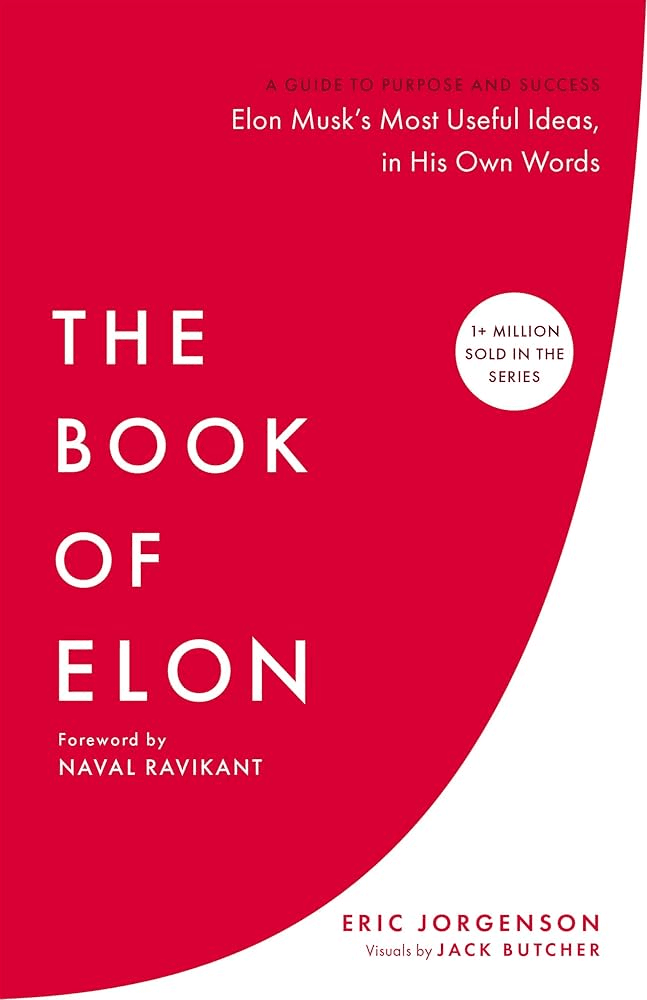
Book Review
The Book of Elon
Elon Musk's most useful ideas, in his own words.
Review
Loved this book. Very inspiring, and packed with Elon maxims worth coming back to.
A reminder of the common-sense business practices that Elon ruthlessly applied to his companies.
Notes & Quotes
Foreword
Naval Ravikant
The only book an entrepreneur needs.
People hate Elon because envy says more about the envious than the envied.
This short life is best spent in the arena, on something other than the mundane and insatiable self.
Part 1
Pursue Purpose
The measure of success in my life is: How many useful things can I get done?
On a day-to-day basis, I wake up in the morning and ask, How can I be useful today?
Ask yourself, is what I'm doing as useful as it could be?
How many people you helped, multiplied by how much help you provided each person, on average.
Try to find an overlap of your talents and what you're interested in. You may have skill in something but don't like doing it. Try to find work that is a good combination of things you are inherently good at but also like doing. Then try to get other people to work with you to create that thing. Keep making it better and better. If you create something useful, money will be the result. That's the way a properly working economy rewards the creation of useful goods and services.
One trait that is similar across all successful entrepreneurs: an obsessive nature about the quality of the product.
If you need encouragement, don't start a company.
Getting people to believe in you and what you're doing is important. In the beginning, very few people will believe in you or what you're doing. Over time, as you make progress, evidence will build. More and more people will start to believe.
You must be extremely tenacious. Work like hell. You have to put in eighty to one hundred hour weeks every week. This will improve your odds of success. Nobody ever changed the world on forty hours a week.
I encourage you to read a lot of books. Just read. Try to ingest as much information as you can.
Most people self-limit their ability to learn. It's pretty straightforward — just read books and talk to people.
Innovation is not the problem. Execution is the problem.
Part 2
Ultra Hardcore Work
I am CEO of these companies because I feel I'm responsible for them, not because it's the best thing for my quality of life.
What you actually get as CEO is a distillation of the worst things going on in the company.
The company looks at me to rally them, so I do. But I feel terrible. Failure is a punch in the gut.
I encounter CEOs who don't know the details of their technology, and that's ridiculous to me.
When the team is being asked to work super hard, I have to be right there with them and they have to see it. If I fall asleep in the middle of the factory floor at four in the morning and wake up four hours later, they see that. They are like, if the CEO is willing to take that level of pain, I can do it too.
Think about war. Do you want the general in some ivory tower or on the front lines?
Wherever Napoleon was, that's where his armies would be at their best. Even if I don't do anything but show up, they'll look at me and know I wasn't spending all night partying.
It is my firm belief that the separation of the workplace into executives and employees does not create a good working environment. We want to create a system of equality without artificial barriers, so someone can start as a trainee and one day lead the entire company. This is why we eliminate all special privileges of executives. Everyone has equal access to parking, eats at the same tables, and there are no management offices. I am convinced that managers should work at the forefront, in the same work environment as the entire team.
I seem to have a high, innate drive, and that's been true even since I was a little kid.
If you don't eat the glass, you're not going to be successful.
Many people fear starting a company too much. What's the worst that could happen? You're not gonna starve to death; you're not gonna die of exposure — really, what's the worst that could happen?
The most important thing is to attract great people. Whether you are creating a company or joining a company, find an amazing group that you really respect.
If you're going to create a company, the first thing you should try to do is create a working prototype.
It doesn't sink in for people until you actually have a physical object they can use. Even when you can show something works on paper, and the calculations are clear, it's not the same.
I consider one of my core responsibilities as CEO is to have an environment where great engineers can flourish.
I don't think I manage smart people; they manage themselves. If someone is smart and talented, they can go anywhere and do anything anytime.
Since a company is a group of people assembled to create a product or service, the ability to attract and motivate great people is critical to the success of a company. That's the purpose of a company. People sometimes forget this elementary truth. If you're able to get talented, hard-working people to join the company, work together, and have a relentless sense of perfection toward a common goal, you will end up with a great product. If you have a great product, lots of people will buy it, and the company will be successful.
The output of any company is the vector sum of the people within it.
I always ask my teams to give a lot of thought to who should join. I recommend paying close attention to people who haven't completed their grad or even undergrad, but are obviously brilliant. Better to have them join before they achieve a breakthrough.
You've got to be willing to recruit hard for excellent people.
Usually the person who had to struggle with the problem really understands it and they don't forget if it was difficult. Ask them detailed questions about it, and they'll know the answers. A person who was not responsible for that accomplishment will not know the details.
If the work is enjoyable, the financial rewards are good, and the product will change the world — that's a pretty powerful set of motivators.
One test for assessing someone's character is to look at the character of their friends and associates. While people can put up a mask themselves for their character, their friends and associates will not. You can judge a person's character by their associates and to some degree by their enemies. If evil people hate you, you might be doing something right.
It's not your job to make people on your team love you. In fact, that's counterproductive. I had a manager who would not fire anyone. I told him, you can't tell people they have to get their shit together and when they don't get their shit together — nothing happens to them. Camaraderie is dangerous. It makes it hard for people to challenge each other's work. There is a tendency to not want to throw a colleague under the bus. That needs to be avoided. Wanting to be everyone's friend leads you to care too much about the emotions of the individual in front of you rather than caring about the success of the whole enterprise. Focusing on that one individual can lead to a far greater number of people being hurt.
Managers should work hard to ensure they are not creating silos within the company that create an us-versus-them mentality or impede communication in any way. This is a natural tendency and needs to be actively fought.
If your hand is on a stove and it gets hot, you pull it right off. But if it's someone else's hand on the stove, it will take you longer to do something about it.
Letting people go is only fair if they can't get themselves motivated around the core mission or they're really not giving it everything they can.
The Elon Algorithm: 1) Make your requirements less dumb. 2) Try very hard to delete the part or process. 3) Simplify or optimize. 4) Accelerate. 5) Automate.
A maniacal sense of urgency is our operating principle.
The power of speed is underappreciated as a competitive factor.
Avoid serialized dependencies. If you can have all those things gestating in parallel, that will substantially accelerate your overall timeline. People tend to serialize too much. Put as many gestating elements in parallel as possible.
Part 3
Becoming a Founder
It's important to take feedback from your environment. If we hadn't responded to what people said, we probably would not have been successful. It's important to look for things like that, focus on them, and correct your prior assumptions.
Better to pick a path and keep moving than just vacillate endlessly on a decision.
Pay close attention to negative feedback, and solicit it, particularly from friends. It's incredibly helpful. This may sound like simple advice, but hardly anyone does it.
It's not a good idea to leave the office when there are a lot of major things underway that are causing people a great deal of stress.
Innovation tends to come from new entrants to an industry.
My default inclination is to start things from scratch — especially after the Tesla experience.
I never wanted to be a CEO, but I learned you could not truly be the chief technology or product officer unless you were the CEO.
I told them we had to go ultrahardcore. They had to prepare for a level of intensity greater than anything they had experienced before.
If you're trying to make a perfect product, attention to detail is essential.
It generally takes three major iterations of any major new technology to have it work really, really well.
The first version is simply about making the new technology work. Then, you work to optimize.
For any company, ask: are the efforts we're expending resulting in a better product or service? If they're not, stop those efforts.
Be pathologically optimistic.
I look for problems that are important to fix for people now and for the future to be good.
There is no point in being pessimistic.
If you're trying to convince the public to do something, you have to think about what will excite people.
What message are we going to try to convey? What will people respond to? What would I respond to if I was an objective member of the public?
Get a money shot — DeepMind's AlphaGo beating a top human, green plants on a red Martian background, and so on.
Don't ask investors to invest their money if you're not prepared to invest your money.
I don't ever give up. I'd have to be dead or completely incapacitated.
We don't want to design to eliminate every risk. Otherwise, we will never get anywhere.
Eliminate what isn't necessary to solve the key problem.
Part 4
On Behalf of Humanity
There is something special — far more rewarding than money — about working with an epic team to make breakthroughs.
If you told a stranger, would they look forward to the day this new thing became available?
The final thing I would encourage you to do is to take risks. Especially before you have kids and other obligations. As you get older, your obligations start to increase. Once you have a family, taking risks affects not just yourself, but your family as well. It gets harder to do things that might not work out. It is easiest to start before you have those obligations. Take risks now, and do something bold. You won't regret it.
Go do it. Just go out there and do it. People are far too afraid to try. Fear is the biggest reason for failure. Don't be afraid to fail. Just go. If you don't push for radical breakthroughs, you're not going to get radical outcomes.
Give internal teams a single score to track. At Tesla, they watched miles-per-intervention for self-driving cars every day — a number that continuously went down and motivated the team.